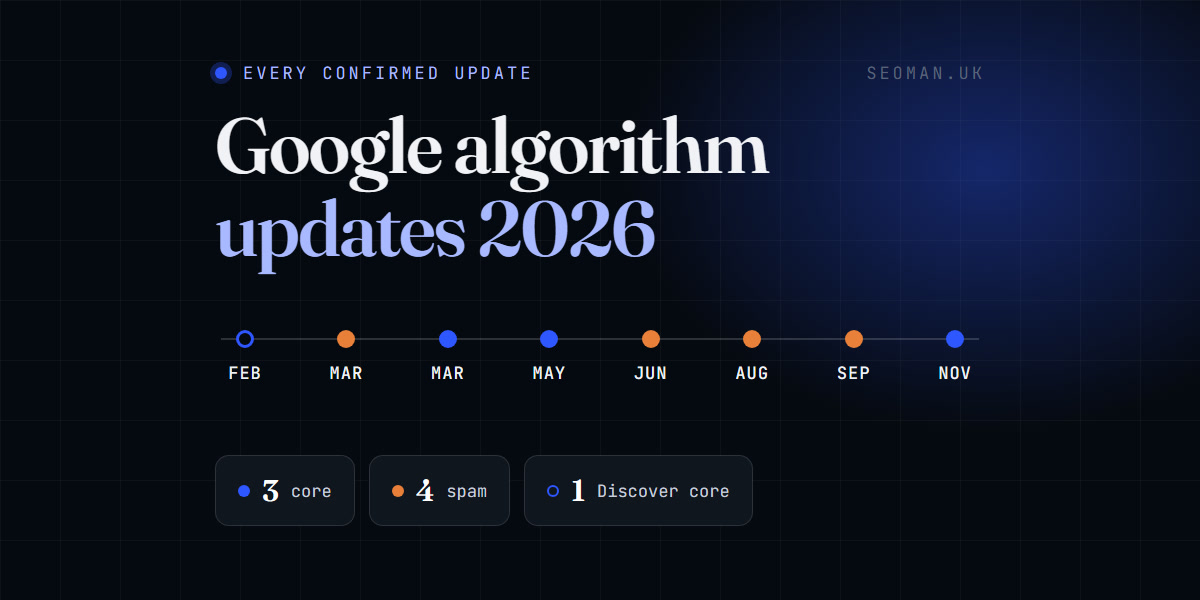
2026 at a glance#
The 2025 Google algorithm updates were fewer: three core updates and one spam update. In 2026 the spam updates alone matched that total, the most in a single year since 2021.
All dates come from the Google Search Status Dashboard. Use them, not the day someone first noticed movement, when you match an update to your own data.
| Update | Dates | Rollout time | What to know |
|---|---|---|---|
| February Discover core update | 5 to 27 February | 21 days 17 hours | Discover feed only. English-language users in the US first. No UK date confirmed. |
| March spam update | 24 to 25 March | 19 hours 30 minutes | Global. The fastest spam update on record. |
| March core update | 27 March to 8 April | 12 days 4 hours | Global. Brand-owned and official sites gained in the main datasets. |
| May core update | 21 May to 2 June | 11 days 21 hours | Global. Search intent and market fit explained the clearest shifts. |
| June spam update | 24 to 26 June | 2 days 1 hour | Global. No new policy announced. |
| August spam update | 18 to 21 August | 2 days 16 hours | Global. No new policy announced. |
| September spam update | 24 September to 8 October | 13 days 16 hours | Global. By far the slowest of the four. Analysts reported large drops. |
| November core update | Started 10 November | Still rolling out on 13 November | Global. Google expects it to take up to two weeks. |
February 2026 Discover core update#
Discover is the feed of articles Google shows in its app and on Android phones. Until February it had never had a core update of its own. Google gave three aims for this one (Google Search Central):
- More local content. Articles from websites based in the reader's own country.
- Less clickbait. Fewer sensational headlines that promise more than the page delivers.
- More expertise. Original, in-depth and timely content from sites that know the subject. Google judges this topic by topic, so a site can be an expert source for one subject and not for another.
The update launched for English-language users in the US, and Google said other countries and languages would follow. As of 13 November there is no confirmed UK date.
One trap to avoid: many UK sites saw rankings move in early February. SISTRIX counted at least 90 established UK domains that lost more than 20% of their search visibility in that period, and said the Discover update was not the cause, because Discover does not feed its search-based index. Google confirmed no core update for web search at that time. If your rankings moved then, this update does not explain it.
What a UK site should take from it: if Discover sends you visitors, the three aims are your brief for when the update arrives here. The preference for home-market sites should help UK publishers with UK readers. Headlines written to bait a click become a risk, and so does content outside the subjects you are known for.
March 2026: a spam update, then a core update#
The March spam update started on 24 March and finished 19 hours and 30 minutes later. Google described it as a normal spam update with no new policy. Two days later, on 27 March, the first core update of the year began. It finished on 8 April (Search Engine Land).
Who gained and who lost
Lily Ray at Amsive studied US visibility for more than 2,000 domains and called the core update a "first-party, official-source correction". Brand-owned and government sites gained. Social platforms, comparison aggregators and other intermediaries lost. YouTube had the largest absolute loss, and Reddit, Instagram, X, TripAdvisor and Yelp also fell.
SISTRIX published UK data that points the same way. Its reading is that brand shops gained over interchangeable retailers, and NHS organisations gained over third-party health content. Some UK examples from its published Visibility Index data, in both directions:
| Site | Before | After |
|---|---|---|
| currys.co.uk | 164.452 | 174.538 |
| pricespy.co.uk | 32.367 | 42.381 |
| blindsbypost.co.uk | 1.276 | 1.805 (up 41.46%) |
| oceanfinance.co.uk | 1.728 | 1.174 (down 32.06%) |
That reading is SISTRIX's interpretation of the movement. Google has not said it targeted any type of site.
The datasets disagree on size
Glenn Gabe found the March core update slower to show and less powerful than December 2025 across the sites he tracks. SE Ranking found the opposite: more volatility than December, with 24.1% of pages in the top 10 dropping out of the top 100 (SE Ranking). SE Ranking also noted that its figure covers the spam update and the core update together, because they ran two days apart.
Both can be true. They measure different sets of sites. The practical point is that a drop between 24 March and 8 April cannot be pinned on one update or the other from a ranking chart alone.
May 2026 core update#
The second core update ran from 21 May to 2 June. Barry Schwartz saw the main impact around 23 and 24 May and judged it larger than March. Glenn Gabe reported rising impact across countries and sectors over the same weekend (GSQi).
The most useful analysis came from Aleyda Solis, who worked through SISTRIX data for the US and the UK. Her conclusion was that three things explained the clearest shifts: search intent, market fit and the type of source Google prefers for a query (Aleyda Solis).
Market fit is the part that matters most for a UK business. In the UK index, local-market retailers gained about 20% in visibility, while US .com marketplaces lost about 55%. A site built for UK customers, with UK prices, delivery and returns, was the better answer for a UK search, and Google moved in that direction.
She also rejected the easy summary that aggregators lost. Some jobs and travel marketplaces that fell in March recovered in May. Forums, question-and-answer sites, sites aimed at the wrong country and tools that repackage other people's information were more exposed.
UK movements in the SISTRIX index
SISTRIX measured little overall change across 451 UK ecommerce domains, and a clearly negative result across 77 UK news domains. These are some of the sites that gained visibility, and some that lost it, in the published UK data between 21 May and 5 June:
| Site | Visibility change | Index points |
|---|---|---|
| marksandspencer.com | Up 25.55% | Up 30.55 |
| wayfair.co.uk | Up 65.13% | Up 20.59 |
| moneysupermarket.com | Up 45.05% | Up 19.00 |
| checkatrade.com | Up 25.78% | Up 6.27 |
| allbeauty.com | Down 44.71% | Down 1.27 |
| seasaltcornwall.com | Down 45.39% | Down 1.31 |
| leasing.com | Down 42.83% | Down 1.19 |
Read these figures with care. They show what can be seen from outside, in one tool's published data. They are movements that happened during the update, not proof of what caused them. And a Visibility Index percentage is not a traffic percentage: a site that gains 25% in visibility has not gained 25% more visitors.
June, August and September spam updates#
The first three spam updates of the year were over in hours or days. June took two days and August under three. Google called both normal spam updates with no policy change, and John Mueller rejected suggestions that the August update had started before it was announced.
September was different. It ran from 24 September to 8 October, almost 14 days, and the people who track these updates reported large drops (Search Engine Journal).
- Glenn Gabe reported large drops across countries and sectors. Many of the sites had the same shape on a chart: a steep climb followed by a collapse. He linked the run of spam updates to sites built to game AI search, which is his view and not something Google has confirmed.
- Lily Ray saw early losses among heavily templated sites that were probably AI-generated, such as sites with a separate page for every phone number or area code. She described this as provisional.
- Barry Schwartz saw three waves of movement: 25 to 27 September, 30 September, and 4 to 6 October. That is his reading of the tracking tools, not three phases confirmed by Google.
Google did not say which techniques it targeted, so "an AI content penalty" is the wrong label. The pattern in the reports is scale without value: thousands of near-identical pages produced from a template. How the pages were written matters less than whether each one gives a visitor something.
Two spam policy changes to know about
- Back-button hijacking. On 13 April Google added it to its spam policies, with enforcement from 15 June. This is when a page stops the browser's back button from returning the visitor to where they came from. Your site can be demoted or given a manual action even when a third-party script causes it, so check what your advertising and pop-up scripts do.
- Manipulating AI answers. Since 15 May the spam policies explicitly cover attempts to manipulate the AI responses in Google Search. More on that below.
Some tactics that were standard recommendations a few years ago now sit inside these policies, which is one reason most SEO advice has an expiry date.
November 2026 core update#
Status on 13 November 2026: still rolling out. Findings will be added here once Google confirms the update is complete.
The third core update of the year started on 10 November. Google called it "a regular update", said it applies globally in all languages, and expects it to take up to two weeks (Search Engine Journal). A full two weeks would end it around 24 November, three days before Black Friday.
What is known so far is very little, and that is normal three days in:
- Glenn Gabe said there was not much to report in the first day.
- SISTRIX is tracking the UK and the US, with its first analysis expected from 16 November.
- No reliable list of UK sites that gained or lost visibility exists yet. Treat any you see this week as guesswork.
A separate fault makes this update harder to read. Between 9 and 11 November a logging error under-reported impressions in Search Console's generative AI report. If that report dipped on those days, it was the fault and not the update.
Google has done this before. The November 2024 core update also arrived in the run-up to Black Friday and took more than three weeks to finish.
For now, avoid large changes to URLs, templates or internal links until the rollout ends. If you change several things during an update, you will not be able to tell what caused a movement.
AI search: the rules changed too#
Several of the year's biggest changes were not ranking updates at all. They changed what you are allowed to do, what Google recommends, and which model writes the answer.
Spam policies now cover AI answers
On 15 May Google stated that its spam policies apply to attempts to manipulate generative AI responses in Search, meaning AI Overviews and AI Mode (Search Engine Roundtable). Paying for mentions so that an AI answer recommends you is now in the same category as paying for links.
Google's own guide to AI features
On the same day Google published its guide to optimising for generative AI features in Search. In short, it recommends:
- Original content built on first-hand experience and expertise, not a rewrite of what already ranks.
- Pages organised for readers, with clear sections and useful images or video.
- Sound technical basics: pages that can be crawled and indexed, and are eligible to show a snippet.
- Accurate Merchant Center and Business Profile details where they apply to you.
- Measuring with Search Console, and treating third-party advice critically.
And it says not to:
- Create a page for every question you imagine someone might ask.
- Assume you need llms.txt, another AI text file or special schema.
- Split content into tiny chunks only for AI.
- Rewrite your pages into an artificial "AI-friendly" style.
- Chase mentions that are not genuine.
- Assume more pages means better quality.
For a small or mid-sized business this is good news. Google's advice is ordinary SEO plus real expertise, which matches the evidence on what works for AI Overviews SEO.
Three smaller changes worth knowing
- FAQ rich results are gone. They stopped appearing in Search on 7 May. FAQ sections are still useful for readers. They no longer earn an expanded listing.
- llms.txt is not needed for Google. On 15 June Google clarified that the file neither helps nor harms visibility in Google Search. Keep it if you use it for other services.
- Links in AI answers became more prominent. On 15 October Google announced more frequent links placed higher inside AI responses. Some of the other link formats it showed were tests. More prominent links do not prove more clicks.
Which model writes the answer
Google changed the models behind its AI features several times in 2026:
- 27 JanuaryGemini 3 becomes the default for AI Overviews worldwide
- MayGemini 3.5 Flash becomes the default in AI Mode, which passes one billion monthly users
- 30 SeptemberGemini 4 Argon is announced, with wider availability from 13 October. Paying subscribers can select it in AI Mode
- 10 NovemberGemini 4 Carbon becomes broadly available, including to AI Ultra subscribers in AI Mode
- 12 NovemberGemini 4 Hydrogen launches in Search for all users
Robby Stein, Google's VP of Product for Search, said Hydrogen is now the default model in AI Mode and is used for the hardest questions in AI Overviews (Search Engine Journal). That does not mean every AI Overview uses it. Google's documentation says AI Overviews and AI Mode can use different models and techniques.
A new model changes which sources get cited, so being cited last month is no guarantee for this month. Citations were unstable even before Hydrogen. A SISTRIX study of more than 82,000 prompts in six countries, including the UK, found that only about 17% of cited domains overlap between AI Overviews and AI Mode for the same prompt. In the UK, more than half of the domains cited in an AI Mode answer were new compared with the week before.
The CMA's rules for Google in the UK
The Competition and Markets Authority imposed its first conduct requirements on Google in June:
- 3 June: publisher conduct requirement. Google must let publishers control whether their content is used in its AI features, and must not penalise them elsewhere in Search for opting out. Google has to comply by 3 December 2026, with controls for individual pages by 3 March 2027.
- 17 June: fair ranking and data portability requirements. The fair ranking rules cover organic results, including those inside AI features, and require Google to give businesses a way to raise concerns. They do not guarantee anyone a ranking.
The CMA defines a publisher as any party that makes content available online. That includes an accountant, a retailer or a trades business with a website, not only newspapers.
The first results are already in Search Console. Generative AI performance reports and a control for opting out of AI features were tested with UK sites from 3 June and rolled out worldwide on 31 August (Search Engine Land). Google says opting out is not a ranking signal for normal results. The reports show impressions only, with no clicks, so anyone deciding whether to opt out is doing it without click data.
The year your data lied: Search Console in 2026#
Before you blame an update for a drop, check whether the number itself was right. In 2026 it often was not.
Impressions were inflated for almost a year
On 3 April Google admitted that a logging error had inflated Search Console impressions since 13 May 2025. It fixed the error on 27 April and confirmed the fix on 4 May (Search Engine Land). Three things follow:
- Clicks were not affected. Click-through rate and average position were, because both are calculated from impressions.
- Google did not correct the old data. Impressions from 13 May 2025 to 27 April 2026 are still too high in your account.
- A fall in impressions at the end of April 2026 is the fix. It is not the March core update arriving late.
The AI report counts impressions, and has had faults
The generative AI report shows how often your pages appeared in AI features. It does not show clicks or search queries. It has also had three logging faults since launch: on 24 June in the Discover version, from 13 August in the Search version, and from 9 to 11 November. Google has acknowledged that people want more data and has announced nothing yet.
OpenAI moved first. Its ChatGPT Business Hub, launched on 10 November, reports clicks as well as mentions.
What the click studies found
| Study | Sample | Finding | Limits |
|---|---|---|---|
| Ahrefs, February 2026 | 300,000 keywords, December 2023 against December 2025 | Click-through rate for position one was 58% lower when an AI Overview appeared | A modelled comparison, not a measured loss for every site. Not UK-only |
| Seer Interactive, April 2026 | 53 brands, 5.47 million queries, January 2025 to February 2026 | Organic click-through rate with an AI Overview rose from about 1.3% in December to 2.36% in February. Without one it was 3.82% | Not UK-only |
| Pew Research, July 2025 | 900 US adults, 68,879 searches | People clicked a normal result on 8% of visits with an AI summary, against 15% without | US only, 2025, and does not cover AI Mode |
The studies use different samples and periods, so the figures cannot be added together, and none of them proves a set click loss for UK sites. They agree on the direction: when an AI answer appears, fewer people click. That is the same pattern as zero-click searches.
How to read your own numbers
- Annotate the dates. Search Console has had chart annotations since November 2025. Add every update in the table above, plus 27 April for the impressions fix.
- Judge by clicks and enquiries. Impressions and average position were the unreliable numbers this year. Clicks, leads and sales were not. These are the SEO metrics that matter to a business owner in any case.
- Compare like with like. Year-on-year impressions for May 2025 to April 2026 are distorted, so say so in the report. There is more on this in how to interpret SEO data for reporting.
- Rule out the other causes. An update is only one of several reasons why organic traffic drops.
What to do now: a checklist for UK site owners#
If an update hit you, how long does recovery take?
Google's core updates guidance is that some improvements take effect within days, while a reassessment of the whole site can take months. In December 2025 it added that smaller core updates happen continually, so a site that has improved does not always have to wait for the next announced update. There are no guarantees.
The year had at least one visible reversal. A payments company that lost visibility in March appeared among the UK gainers in May. That shows visibility can come back between updates. It does not show what brought it back.
Questions people ask about the 2026 updates#
How many Google algorithm updates were there in 2026?
Eight confirmed ranking updates as of 13 November: three core updates, four spam updates and one Discover core update. Google also makes smaller, unannounced changes throughout the year.
Has the November 2026 core update finished?
Not as of 13 November 2026. It started on 10 November and Google expects it to take up to two weeks.
Has the Discover core update reached the UK?
Google has not confirmed a UK date. The update launched for English-language users in the US in February, with other countries to follow.
Did Google penalise AI-written content in 2026?
Google did not announce a penalty for AI-written content. The sites reported as hit in the spam updates were producing large numbers of near-identical pages. Google's guidance, updated on 1 October, asks for accuracy, fact-checking and added value. It does not ban AI-assisted writing.
The short version: 2026 rewarded sites that are the real source for their market: the brand, the official body, the UK business serving UK customers. It punished pages made in bulk. Most of the panic came from numbers that were wrong, so check the date and the metric before you change anything.