What launched#
OpenAI's announcement covers three things (OpenAI):
A claimed profile. Once verified, you can update your website, description, category, logo, and delivery and returns policies. Verified profiles get a blue tick.
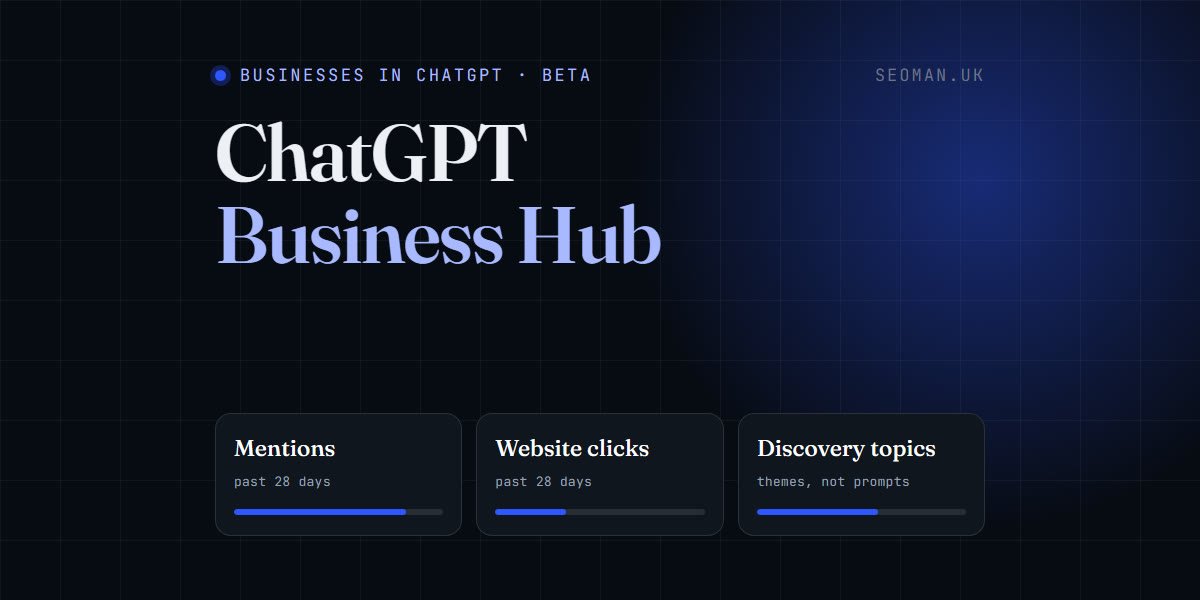
Insights. Mentions, website clicks and "discovery topics" (the themes of the answers you appear in).
Business Agents. A chatbot for your business inside ChatGPT. This part is only open to eligible ecommerce and online service businesses in the US.
You don't need to advertise or have an enterprise contract to claim. No price is listed, so for now it costs nothing.
What the data shows, and what it hides#
The Insights tab covers the past 28 days. The definitions matter more than the numbers, so read them before you report anything (OpenAI Help Center):
- Mentions. For an online business, a mention only counts when ChatGPT references your website. Your brand name on its own doesn't count. For a local business, it counts when ChatGPT shows a result for that location.
- Website clicks. Clicks on links to your site inside ChatGPT. OpenAI's own tooltip warns that a click doesn't confirm a visit or a conversion.
- Discovery topics. Grouped themes, not the questions people typed.
What you don't get:
- No prompts and no conversations, including chats with your own agent.
- No competitor data and no share of voice.
- No figures at all below a privacy threshold. A blank metric doesn't mean zero.
- No way to manage several brands or locations in one place.
So it's closer to a Google Business Profile with a small performance report than to Search Console. Several people made the same point on launch day, and the ID check you'll meet further down supports it.
It also isn't the first time you can see ChatGPT traffic. GA4 already records some of the clicks as referrals from chatgpt.com. What's new is the other side of the sum: how often you were shown. Put the two together and you finally have a rough click-through rate from a source that isn't a third-party estimate.
Can a UK business claim one?#
OpenAI says any eligible business located where ChatGPT is available can claim. In practice it depends on what kind of business you are:
- Online shops. Yes. You can claim an existing listing or add your own, and Shopify stores can verify by connecting the store.
- Businesses with premises. OpenAI's help page says local shops and restaurants can currently only claim an existing US listing. In practice, UK companies with an office address are already listed, and the claim button is there. Pressing it doesn't mean you get in today, though. A UK business that started its claim the day after launch got this instead: "You're on the waitlist. We'll email you when you can continue claiming [business name] in ChatGPT." If you see that, nothing has gone wrong. You're in the queue.
- Service businesses with no premises. Not yet for everyone. Aleyda Solís found the "through a service" option marked as coming soon when she tried to claim her consultancy (LinkedIn).
The only way to know is to search for your business, start the claim and see what you're offered.
How claiming works#
- Sign in to ChatGPT and open Business Hub.
- Search for your business and select the matching listing.
- Verify your connection to it: a code sent to the business phone or email, a TXT record on your domain, or a Shopify login.
- Wait for OpenAI to review the claim.
- Pass an identity check with Persona. Expect to be asked for government photo ID, company registration details and proof that you can represent the business.
Until step 5 is approved you can't edit the profile or see any figures. Four things to know before you start:
- The right person has to do it. That means an owner or director, not your agency and probably not your marketing executive. They can give teammates or an agency access afterwards.
- Use a company account if you have one. If the claim is made inside a company ChatGPT workspace, the people you invite later may need to be members of it.
- You may land on a waitlist. Some UK businesses are being queued after they start the claim. The email telling you to continue goes to the address on the ChatGPT account you used, so claim with an account whose inbox somebody reads.
- Don't create a duplicate. If your listing exists, claim it. OpenAI says its support team can't delete, unpublish or hide a published profile.
What people in search have found so far#
I spent the morning after launch reading what the people I trust in this industry had posted. The useful findings:
- Lily Ray got access early and saw 8 clicks from 26 mentions, about 31%. She reads that as a result of the definition: a mention with a link is close to a recommendation, so it gets clicked far more than an ordinary search result. It's also one site and a tiny sample (LinkedIn).
- Juozas Kaziukėnas, who spotted the feature being built back in August, reports that topics are limited to the five most common themes (LinkedIn).
- David Konitzny dug through ChatGPT's code and found that profiles sit on top of the brand entities ChatGPT already recognises, and that ownership disputes and sponsored routes into Business Agents are already built in (LinkedIn).
- Barry Schwartz verified by DNS and had no data on day one, while others did. He's also uneasy about people hijacking listings that aren't theirs (Search Engine Roundtable).
- Steve Toth points out that with a 28-day window you need to record the figures yourself, weekly, or you'll have no history (LinkedIn).
- Glenn Gabe hopes click data from OpenAI pushes Google into showing clicks for its own AI features in Search Console (LinkedIn).
- Carl Hendy is the sceptic: he doesn't think OpenAI has suddenly started caring about site owners, and sees this as groundwork for advertising (LinkedIn).
What it won't do#
Claiming doesn't make ChatGPT recommend you more often. OpenAI says so directly, and adds that advertising doesn't influence ChatGPT's independent answers either. A claimed profile gives you accurate details and a report. Whether you get mentioned still comes down to your website, your reviews and what other trusted sites say about you.
That's the same conclusion I reached about Google's AI features: there is no special trick for getting cited in AI Overviews, and there isn't one here.
Keep the scale in proportion too. On the sites I look after, AI assistants still send a small fraction of what Google does, which is the pattern behind zero-click searches: being shown matters more and more, and the click matters less. Business Hub is useful because it starts to measure the "being shown" part.
What I'd do this week#
The short version: Business Hub won't change how visible you are in ChatGPT. It will tell you, with OpenAI's own numbers, how visible you already are. Claim it early so your data starts from the first day you can get it.