Search engine optimisation (SEO) is one of the most valuable digital marketing strategies for businesses today, helping brands increase visibility, attract organic traffic, and drive revenue. At the heart of these efforts is the SEO manager, a professional responsible for planning and executing strategies to ensure a website appears in search results for the right audience.
Despite its importance, the SEO manager role is often misunderstood. Some believe SEO managers only handle keywords and backlinks, while others assume they focus purely on technical aspects of website performance. The reality is that an SEO manager is responsible for both strategic and technical initiatives, collaborating with multiple teams to ensure long-term success in search rankings.
This guide is designed for two key audiences:
- Aspiring SEO professionals – Those looking to build a career in SEO and understand what the role entails.
- Business owners and hiring managers – Those evaluating whether they need an SEO manager and how to find the right candidate.
By the end of this guide, you’ll have a complete understanding of the SEO manager role, its responsibilities, and how it fits into a modern digital marketing strategy.
Why SEO is critical for businesses today
More than 90% of online experiences begin with a search engine, making SEO one of the most important digital marketing channels. In an era where competition is increasing and paid advertising costs are soaring, businesses that invest in SEO enjoy sustainable, high-intent traffic that delivers long-term return on investment (ROI). To achieve this, it’s essential to understand the top factors that affect your organic traffic.
Key benefits of SEO for businesses
- Sustained growth – Unlike paid ads, which stop delivering traffic when the budget runs out, SEO efforts continue driving organic visibility over time.
- Increased credibility and trust – 75% of users never go past page one of search results, and high-ranking websites are viewed as more trustworthy and authoritative.
- Higher ROI than paid media – Studies show that organic search generates more clicks than paid ads, meaning businesses that rank well attract more customers without constant ad spend.
- Competitive advantage – Companies that invest in SEO gain a long-term edge over competitors, as ranking well for high-value keywords translates into ongoing business growth.
A well-structured SEO strategy is no longer optional – it’s essential for digital success. SEO managers play a crucial role in developing, executing, and optimising these strategies to ensure businesses stay visible in search results.
Understanding the potential costs involved can help in making an informed decision. Learn more about SEO pricing and budgeting here.

What is an SEO manager?
An SEO manager is a digital marketing professional responsible for improving a website’s visibility in search engines. This involves technical improvements, content optimisation, data analysis, and strategy development.
SEO managers are both strategists and executors, ensuring that SEO efforts align with business objectives and deliver measurable results.
Experience levels within SEO management
Understanding the progression within SEO roles is crucial for both career planning and hiring decisions.
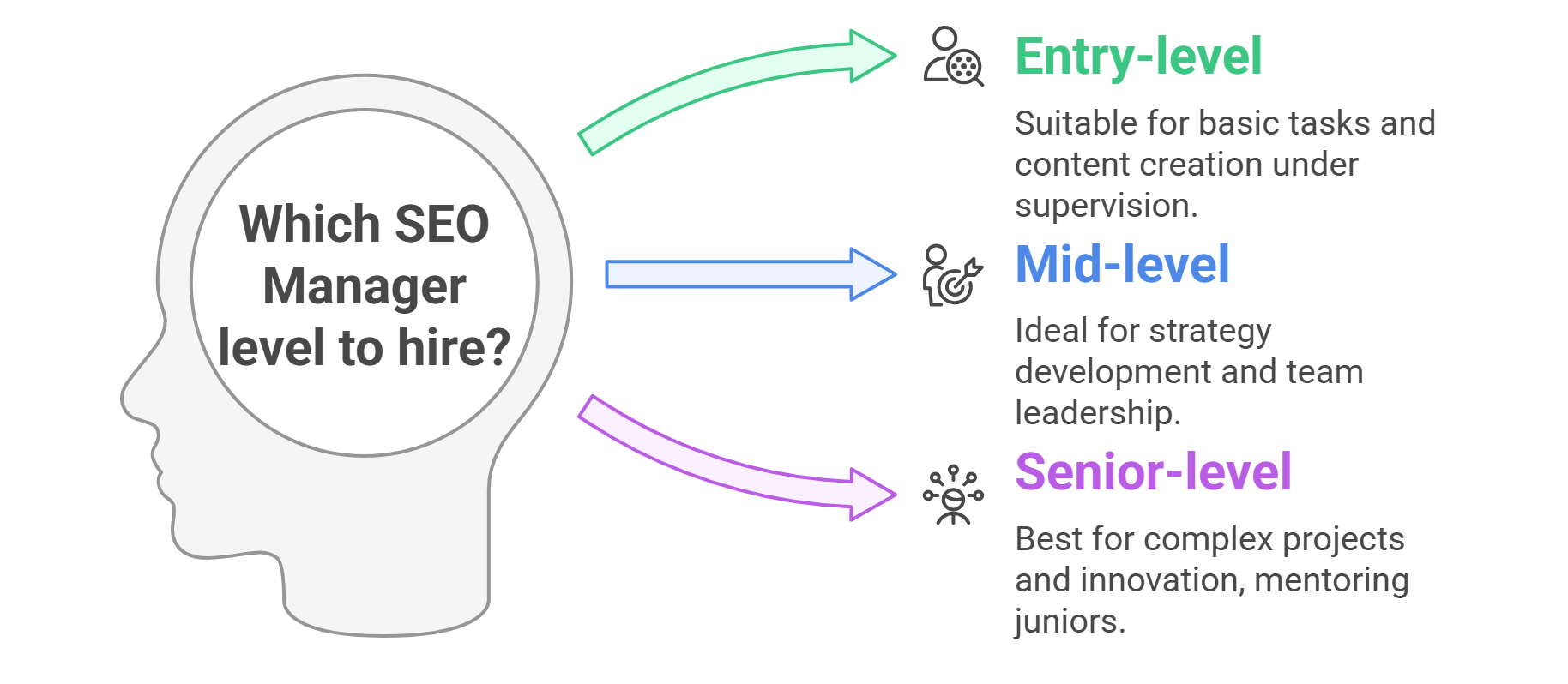
- Entry-level SEO Manager: Typically has 1-3 years of experience. Focuses on executing tactical optimisations and creating optimised content. Works under the guidance of senior team members and is responsible for basic SEO tasks like keyword research and on-page optimisation.
- Mid-level SEO Manager: With 3-5 years of experience, oversees SEO processes and may lead small teams. Develops and implements SEO strategies, collaborates with other departments to align SEO efforts with business objectives, and conducts performance analysis and reporting.
- Senior SEO Manager: Boasts over 5 years of experience. Leads larger teams and complex SEO projects, develops comprehensive SEO strategies aligned with overall business goals, focuses on innovation and solving complex problems, contributes to the overall digital marketing strategy, and may mentor junior team members.
This progression highlights the increasing levels of responsibility, strategic involvement, and leadership expected as one advances in an SEO career.
SEO manager vs. SEO content manager vs. technical SEO manager
The SEO industry has various specialisations, and different roles focus on different aspects of optimisation:
- SEO manager – Oversees the entire SEO strategy, manages teams, and ensures that SEO aligns with broader business goals.
- SEO content manager – Focuses on content strategy, keyword targeting, and blog/article optimisation to ensure high-ranking, engaging material.
- Technical SEO manager – Specialises in site structure, page speed, crawlability, indexing, schema markup, and Core Web Vitals to improve performance.
- SEO analyst – Works primarily with SEO data and reporting, measuring performance metrics and identifying areas for improvement.
- Link-building specialist – Focuses on acquiring high-quality backlinks, digital PR, and improving off-page authority.
Understanding these specialisations allows businesses to build a structured SEO team and helps SEO professionals choose the right career path.

What does an SEO manager do? (Key responsibilities)
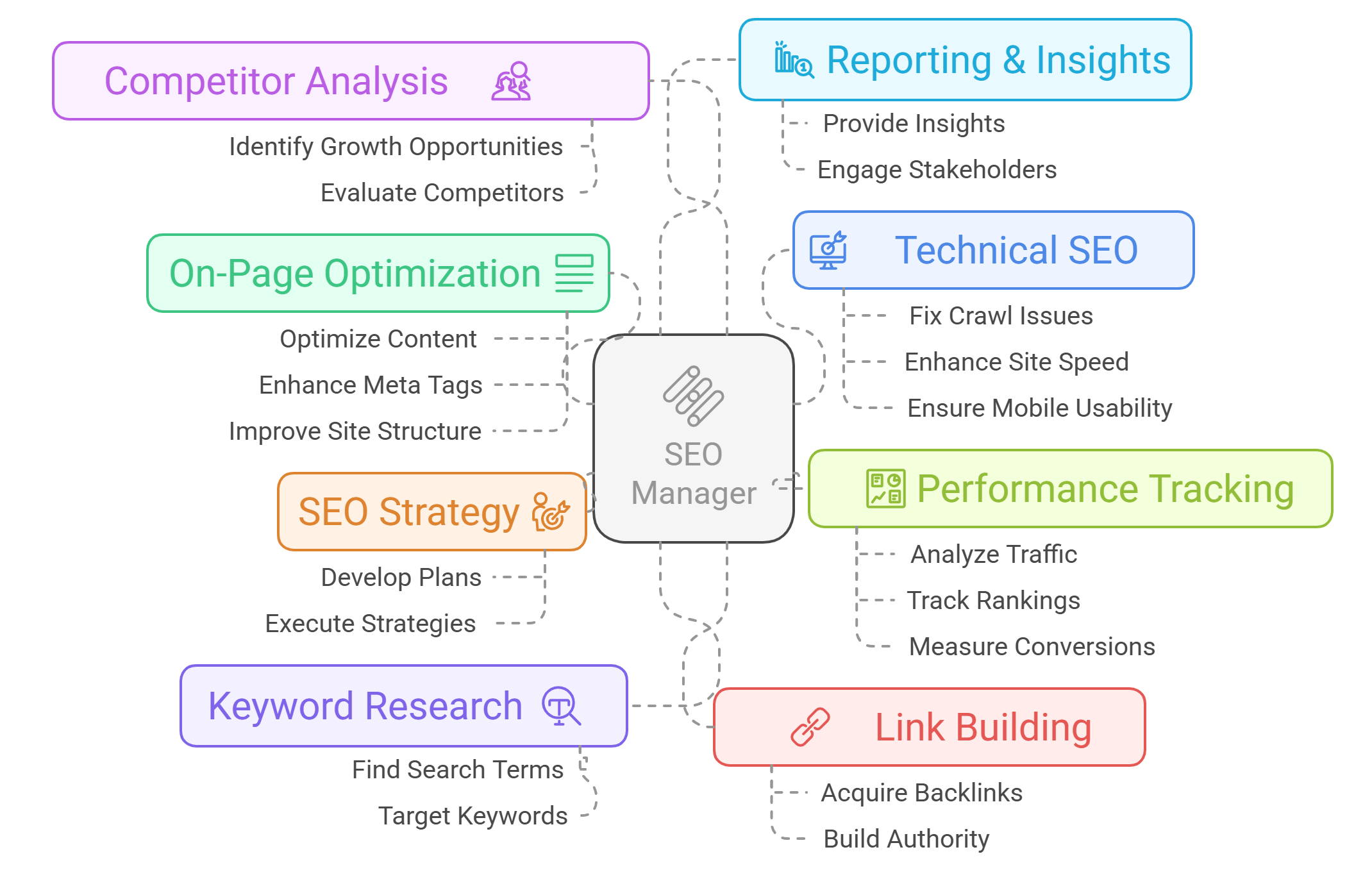
SEO managers wear many hats, as their role blends technical expertise, content strategy, and data-driven decision-making. Their responsibilities include:
1. Developing and implementing SEO strategies
- Creating a comprehensive SEO roadmap aligned with business objectives.
- Conducting competitor analysis to identify growth opportunities.
- Developing short-term and long-term strategies based on market trends.
2. Conducting keyword research and search intent analysis
- Identifying high-value keywords aligned with user intent and search demand.
- Using tools like Ahrefs, SEMrush, and Google Keyword Planner to track trends.
- Creating a keyword mapping strategy for content teams.
3. On-page SEO optimisation
- Optimising meta titles, descriptions, headings, and images for better rankings.
- Enhancing internal linking structures for improved crawlability.
- Ensuring high readability and UX-focused content structure.
4. Technical SEO and site audits
A technical SEO manager focuses on improving website performance, structure, and indexability to ensure search engines can crawl and rank content effectively.
Their key responsibilities include:
- Crawlability and indexing – Fixing issues with robots.txt, XML sitemaps, and canonical tags.
- Site speed optimisation – Improving loading times using CDNs, image compression, and lazy loading.
- Core Web Vitals – Enhancing LCP (Largest Contentful Paint), FID (First Input Delay), and CLS (Cumulative Layout Shift) for better UX.
- Schema markup implementation – Adding structured data to improve visibility in rich snippets.
- Mobile optimisation – Ensuring seamless performance across all devices.
Technical SEO ensures that a website meets the technical requirements of modern search engines, such as a secure connection, a responsive design, and a fast loading time. On the other hand, content strategy involves planning, creating, and managing content that is not only engaging but also optimised for search engines.
An effective SEO manager must balance both aspects to enhance a website’s visibility and user experience.
5. Content strategy and SEO copywriting
- Collaborating with content teams to produce optimised, high-quality content.
- Implementing topic clusters and pillar pages for better site structure.
- Ensuring content meets E-E-A-T (experience, expertise, authority, trustworthiness) principles.
6. Link-building and off-page SEO
- Acquiring high-authority backlinks to strengthen domain credibility.
- Managing local SEO strategies, including Google Business Profile.
- Engaging in digital PR and influencer partnerships.
7. SEO performance tracking and reporting
- Analysing organic traffic, keyword rankings, and user behaviour.
- Using tools like Google Analytics, Google Search Console, and Ahrefs.
- Presenting SEO insights to stakeholders and business leaders.

SEO manager salaries in the UK and US
Salaries vary depending on experience, location, and specialisation.
United Kingdom:
- Entry-level SEO manager – £30,000 – £45,000 per year
- Mid-level SEO manager – £45,000 – £70,000 per year
- Senior SEO manager – £70,000 – £100,000+ per year
United States:
- Entry-level SEO manager – $40,000 – $60,000 per year
- Mid-level SEO manager – $60,000 – $90,000 per year
- Senior SEO manager – $90,000 – $150,000+ per year
FAQ – What does an SEO manager do?
What does an SEO manager do daily?
An SEO manager’s daily tasks include keyword research, on-page optimisations, technical audits, backlink strategy, content planning, performance tracking, and staying updated with search engine algorithm changes.
How do I know if my business needs an SEO manager?
If your website isn’t generating organic traffic, ranking well for key terms, or converting visitors into leads, hiring an SEO manager can help diagnose and fix these issues. Businesses that rely on search visibility for leads and revenue will benefit the most.
What are the most important skills for an SEO manager?
An SEO manager must have expertise in keyword research, technical SEO, content strategy, analytics, link building, and project management. Strong communication skills are also important for working across departments and aligning SEO with business goals.
How long does it take to see results from an SEO manager’s work?
SEO is a long-term strategy. Most businesses start seeing measurable improvements in 3 to 6 months, but competitive industries may take 6 to 12 months for significant ranking improvements. The timeline depends on factors like competition, website health, and SEO investment. However, as tested in February 2025, some websites can start and grow in visibility in less than a week. Google has become more receptive to high-quality content and “good” websites, making it possible for well-optimised, valuable content to gain traction much faster than before.
Is it better to hire an SEO manager or work with an SEO agency?
Hiring an in-house SEO manager is ideal for long-term strategy and integration within your business. An in-house manager works closely with your internal teams and has a deeper understanding of your brand. However, if you need fast results, broad expertise, or a short-term project, an SEO agency may be a better fit. Agencies provide access to specialists and resources that an in-house manager might not have.
Can SEO managers guarantee top rankings on Google?
No ethical SEO manager can guarantee top rankings, as Google’s algorithms are constantly changing. A good SEO manager will focus on sustainable, white-hat strategies that improve visibility over time. While SEO efforts can significantly increase rankings, factors like competition, algorithm updates, and website quality all impact results.
What industries benefit the most from hiring an SEO manager?
Industries that rely on organic search, such as e-commerce, SaaS, local services, healthcare, and finance, benefit the most from dedicated SEO management. Any business that wants to increase online visibility and organic leads can benefit from hiring an SEO expert.
How much does an SEO manager cost in the UK?
Entry-level SEO managers typically earn between £30,000 and £45,000 per year. Mid-level SEO managers can expect salaries ranging from £45,000 to £70,000 per year. Senior SEO managers with extensive experience and strategic expertise can earn between £70,000 and £100,000+ per year, depending on industry and company size.
What key performance indicators should I track for an SEO manager?
Important KPIs to track include organic traffic growth, conversion rates from organic search, keyword rankings, backlink quality and authority, page speed, and mobile-friendliness. Monitoring these metrics helps businesses assess the effectiveness of their SEO efforts and adjust strategies accordingly.
Can an SEO manager replace an SEO agency?
An SEO manager can handle most in-house SEO tasks, but agencies may still be beneficial for large-scale link-building, technical audits, and specialised SEO services. If your business requires a full-service approach, combining an in-house SEO manager with agency support can be the best solution.
How do I measure the success of an SEO manager?
The success of an SEO manager should be measured by improvements in organic traffic, keyword rankings, lead generation, and ROI. A well-executed SEO strategy should show consistent growth in search visibility and business conversions over time.

Hiring or becoming an SEO manager
For aspiring SEO professionals, the role of an SEO manager offers growth opportunities, high demand, and strong earning potential. It’s an exciting field that combines data analysis, creativity, and technical expertise.
For businesses, hiring an SEO manager – or a specialist like an SEO content manager or technical SEO manager – is one of the smartest investments for long-term online success.
By understanding these SEO roles and responsibilities, businesses can build high-performing SEO teams, and professionals can confidently advance their careers.